


Quick answer: which loan fits your goal?
If you are weighing personal loan vs home loan options, start with the job you need the money to do.
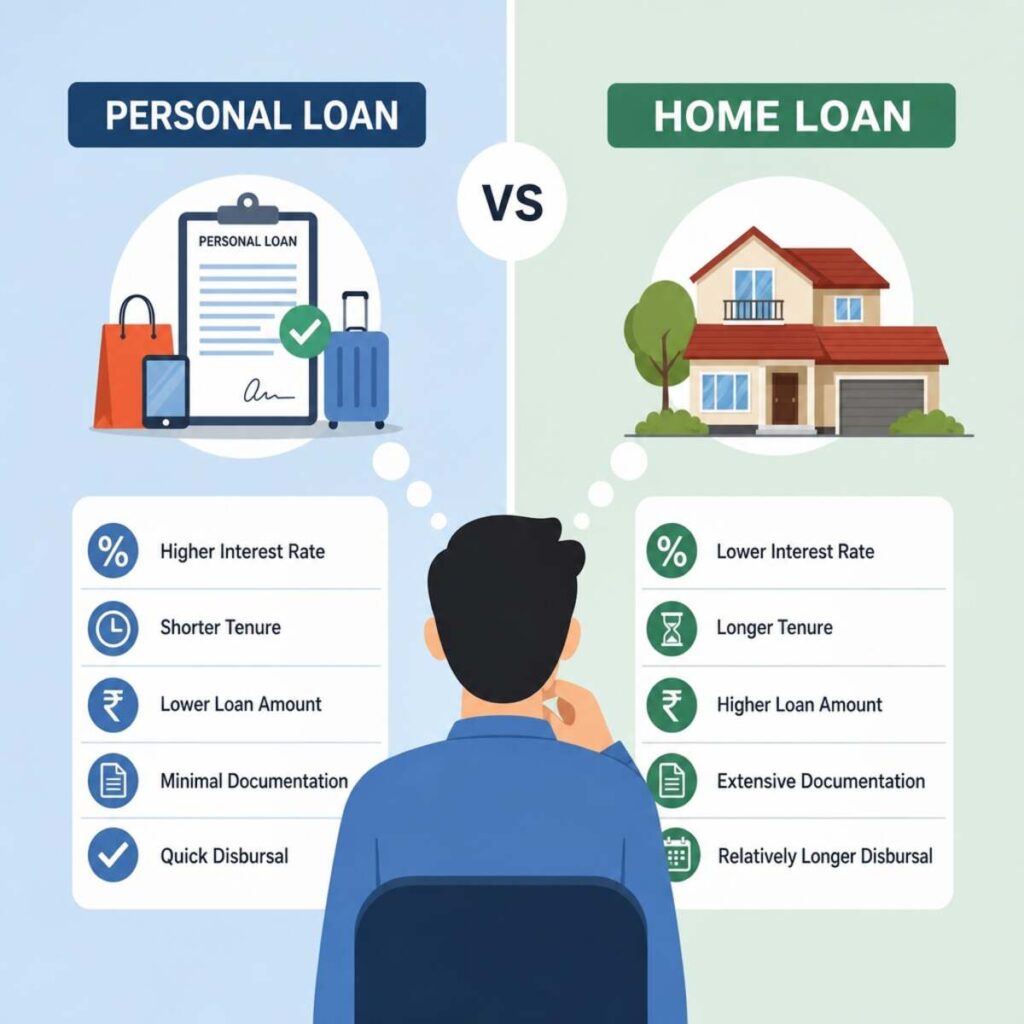
A personal loan is usually the cleaner fit when you need a smaller lump sum, want faster funding, and do not want to pledge your home as collateral. It can work for debt consolidation, medical bills, moving costs, appliance replacement, a modest renovation, or another one-time expense.
A home loan is usually the stronger fit when the financing is tied to real estate: buying a home, refinancing a mortgage, tapping home equity, or funding a major home improvement project. It may offer lower loan interest rates than many unsecured personal loans, but it also brings more paperwork, closing costs, longer repayment terms, and the serious risk of losing the property if you default.
For this comparison, “home loan” means a loan secured by residential real estate, such as a purchase mortgage, refinance, home equity loan, or home equity line of credit. The right answer depends on your purpose, credit profile, income, home equity, timeline, and comfort with collateral.
The short version:
- Choose a personal loan if speed, simplicity, and no home collateral matter most.
- Choose a home loan if you need a larger amount, can handle a longer approval process, and the property-backed structure makes financial sense.
- Compare APR, not just the interest rate, because fees can change the true cost of borrowing.
- Never use a home-secured loan casually. A low rate is not a bargain if it puts your house at unnecessary risk.
Recent rate context is useful, but not a substitute for live quotes. Freddie Mac reported that the average 30-year fixed-rate mortgage was 6.49% as of July 9, 2026, while the Federal Reserve’s G.19 release tracks separate commercial-bank benchmarks for 24-month personal loans. Your actual APR can be higher or lower based on credit, income, debt, loan type, property details, lender fees, points, and timing. (freddiemac.gcs-web.com)
Side-by-side comparison snapshot
Think of this as the “coffee table” version before we get into the fine print.
Purpose
Personal loan: Best for flexible, non-real-estate borrowing needs. Common uses include consolidating high-interest debt, covering emergency expenses, paying for a move, replacing a major appliance, funding a small home repair, or handling a one-time personal cost.
Home loan: Best for home-related financing. Common uses include buying a property, refinancing an existing mortgage, borrowing against home equity, or paying for major renovations.
Collateral
Personal loan: Often unsecured, meaning you do not pledge a specific asset. Some personal loans are secured by savings, a vehicle, or another asset.
Home loan: Secured by real estate. If you fail to repay, the lender may have the right to foreclose under the loan documents and state law.
Loan interest rates and APR
Personal loan: Often carries a higher APR than a comparable home-secured loan because the lender may not have collateral. Many personal loans have fixed rates and fixed monthly payments.
Home loan: Often has a lower interest rate because the loan is secured by property, but closing costs, points, mortgage insurance, and a long repayment term can increase the total cost.
Repayment term
Personal loan: Usually shorter. Many borrowers repay over a few years, which can mean higher monthly payments but a faster payoff.
Home loan: Usually longer. Purchase mortgages often use 15-year or 30-year structures, and home equity products may also offer extended repayment periods. The CFPB notes that longer mortgage terms typically lower monthly payments but can cost more over the life of the loan. (consumerfinance.gov)
Fees
Personal loan: May include origination fees, documentation fees, optional insurance products, non-filing insurance on secured loans, and late fees. The CFPB advises borrowers to review required disclosures and compare offers from multiple lenders. (consumerfinance.gov)
Home loan: May include origination charges, discount points, appraisal fees, title charges, government fees, prepaid expenses, escrow deposits, and mortgage insurance. The CFPB says the total matters because lenders may label or itemize these charges differently. (consumerfinance.gov)
Funding speed
Personal loan: Often faster. Online lenders, banks, and credit unions may approve and fund quickly if your documents are ready.
Home loan: Usually slower. A mortgage or home equity loan commonly requires underwriting, property review, title work, closing disclosures, and sometimes an appraisal.
Tax considerations
Personal loan: Interest for personal expenses is generally not deductible. The IRS lists credit card and installment interest incurred for personal expenses as personal interest that is not deductible. (irs.gov)
Home loan: Mortgage interest may be deductible if IRS rules are met. The IRS states that home mortgage interest is deductible on the first $750,000 of indebtedness for many newer loans, with higher limits applying to certain older debt. Interest on home equity loans and lines of credit is deductible only when funds are used to buy, build, or substantially improve the home that secures the loan. (irs.gov)
What is a personal loan?
A personal loan is installment financing. You borrow a lump sum, receive the funds, and repay the debt through scheduled payments over a set term. Many personal loans are unsecured, so approval leans heavily on your credit score, income, debt-to-income ratio, credit history, and overall ability to repay.
Personal loans are popular because they are flexible. A lender may allow funds to be used for debt consolidation, emergency expenses, home repairs, large purchases, or personal projects. The tradeoff is that flexibility can come at a cost. Without home collateral, a lender may charge a higher APR, especially for borrowers with fair or damaged credit.
A personal loan may be a smart financing option when the expense is clear, the payoff timeline is short, and the monthly payment fits comfortably into your budget. It is less ideal when the loan merely delays a cash-flow problem, pays for lifestyle spending you cannot afford, or consolidates credit card debt without changing the habits that created the balances.
What is a home loan?
A home loan is financing tied to real estate. The most common type is a mortgage used to buy a home. Other home loan structures include mortgage refinancing, home equity loans, and HELOCs.
With a home loan, the property usually serves as collateral. That collateral can help make the rate more competitive, but it also raises the stakes. If you default, you are not only risking credit damage or collection activity. You may be risking your home.
Home loans also tend to be more complex than personal loans. A lender may evaluate your credit, income, assets, debts, down payment, home equity, property condition, title status, insurance, and the type of loan program. That is why home loans usually take longer and involve more fees than a standard personal loan.
Still, when the borrowing need is large and home-related, a home loan can be powerful. It can help you buy a property, lower an existing mortgage payment through refinancing, or fund improvements that may increase comfort, function, or long-term property value.
Key differences between personal loans and home loans
1. Purpose: flexible cash vs property-focused financing
A personal loan is the more flexible tool. It is not automatically tied to a property purchase or home equity position. If your furnace breaks, your dog needs surgery, or you want to consolidate several credit card balances into one fixed payment, a personal loan may be worth comparing.
A home loan is more specialized. A purchase mortgage is designed to help you buy real estate. A refinance replaces or modifies an existing mortgage. A home equity loan or HELOC lets you borrow against equity you already have in a property.
Here is the practical dividing line: if the expense is not connected to a home and you do not need a very large amount, a personal loan may be simpler. If the expense is connected to buying, improving, or refinancing a home, a home loan may offer a better structure.
2. Collateral: no pledged home vs property-backed debt
Collateral is one of the biggest differences in the personal loan vs home loan decision.
Most personal loans are unsecured. That does not mean there are no consequences if you miss payments. Late payments can damage your credit, and a default can lead to fees, collections, or legal action. But your home is not automatically pledged as collateral unless the loan is specifically secured by it.
Home loans are secured by real estate. That is why lenders may be willing to offer larger amounts or more favorable rates. But it also means the property is part of the deal. If you stop paying, the lender may pursue foreclosure.
This is where many borrowers get dazzled by a lower rate and forget the risk transfer. A home loan can be cheaper on paper and more dangerous in real life if the money is used for short-lived expenses or unstable debt repayment.
3. Rates and APR: the rate is only one chapter
Loan interest rates matter, but APR gives a fuller story. The interest rate tells you the cost of borrowing the principal. APR helps reflect the broader cost of credit, including certain fees. The CFPB describes APR as one measure of a loan’s cost and encourages borrowers to use the Loan Estimate to compare offers. (consumerfinance.gov)
Personal loans often have higher APRs than home loans because unsecured lending creates more risk for the lender. But the shorter term can limit how long interest accrues. That means a personal loan with a higher APR may still cost less in total interest than stretching the same expense over a long home loan term.
Home loans may offer lower rates, but the closing costs can be substantial. Points can also complicate the comparison. A discount point is an upfront cost paid to lower the interest rate, and the CFPB notes that one point equals 1% of the loan amount. Lender credits work in reverse: you may pay less upfront, but accept a higher rate over time. (consumerfinance.gov)
Guru tip: do not ask, “Which rate is lower?” Ask, “Which option gives me the lowest total cost for the amount of time I expect to keep this loan?”
4. Repayment terms: shorter payoff vs long runway
Personal loans usually have shorter repayment periods. This creates two effects. First, your monthly payment may be higher because the debt is compressed into fewer years. Second, you may pay less total interest because the debt is gone sooner.
Home loans often have long repayment periods. A 30-year mortgage can make a large purchase feel manageable because the payment is spread out. But long terms can make total interest much larger, even when the rate is relatively low.
Neither structure is automatically better. A longer term can help with affordability and cash flow. A shorter term can reduce debt faster and limit total interest. The right choice depends on your monthly budget, emergency savings, future plans, and how long the financed item will remain useful.
5. Fees: personal loan charges vs mortgage closing costs
Personal loan fees are usually simpler. You may see an origination fee, late fee, documentation fee, or optional add-on products. Some lenders deduct the origination fee from your loan proceeds, meaning you receive less than the amount borrowed. Always check whether fees are paid upfront, financed into the loan, or subtracted from disbursement.
Home loan fees are more layered. You may pay lender charges, points, appraisal fees, title fees, recording fees, prepaid interest, homeowners insurance, property tax escrows, and mortgage insurance. On a purchase mortgage, some costs are related to buying the home rather than borrowing money. The CFPB’s Closing Disclosure explainer separates principal and interest from other payment components like taxes, insurance, mortgage insurance, and escrow-related charges. (consumerfinance.gov)
When comparing fees, do not get hypnotized by labels. “No closing cost” often means costs are rolled into the loan or exchanged for a higher rate. “Low rate” may come with points. “No origination fee” may still come with a higher APR. The full math matters.
6. Funding speed: quick cash vs underwritten property process
If time is the top priority, personal loans usually win. A lender may be able to approve and fund a personal loan quickly, especially if your income, identity, bank account, and credit information are easy to verify.
Home loans usually take more time because the property is part of the approval. The lender may need to review title, property value, insurance, appraisal, homeowners association details, and closing documents. A home loan is not just about whether you qualify. It is also about whether the property and transaction qualify.
For urgent repairs, a personal loan may be practical. For a major renovation or purchase, a home loan may be worth the extra time.
7. Tax treatment: do not assume a deduction
This is a classic borrower mistake: assuming all home-related borrowing creates a tax break.
Personal loan interest used for personal expenses generally is not deductible. The IRS includes installment interest incurred for personal expenses in its list of nondeductible personal interest. (irs.gov)
Home loan interest may be deductible, but only if the debt and use of funds meet IRS rules. For home equity loans and HELOCs, the IRS says interest is deductible only when borrowed funds are used to buy, build, or substantially improve the taxpayer’s home that secures the loan. (irs.gov)
Translation: do not choose a home loan solely because you heard the interest is deductible. Talk with a qualified tax professional, especially if you are using home equity for mixed purposes, business use, rental property, or a large loan.
Eligibility and requirements
Personal loan requirements
Personal loan approval varies by lender, but you can expect a review of:
- Credit score and credit history
- Income and employment or other reliable income sources
- Debt-to-income ratio
- Existing loan and credit card obligations
- Requested loan amount
- Loan purpose, depending on lender rules
- Identity verification
- Bank account information for funding and payments
- Collateral details, if applying for a secured personal loan
Stronger credit and lower debt generally help you qualify for better loan interest rates. If your credit is thin or damaged, a lender may offer a higher APR, smaller amount, secured loan option, or require a co-borrower.
Before applying, check your credit reports, estimate your monthly payment, and compare prequalified offers when available. Prequalification may use a soft credit check, but a formal application can involve a hard inquiry.
Home loan requirements
Home loan approval is more involved. Lenders commonly review:
- Credit score and credit report
- Income documentation, such as pay stubs, W-2s, tax returns, or business financials
- Employment history or income stability
- Debt-to-income ratio
- Assets and reserves
- Down payment or home equity
- Property value
- Appraisal or valuation results
- Title review
- Homeowners insurance
- Mortgage insurance requirements, if applicable
- Loan program rules for conventional, FHA, VA, USDA, jumbo, or other products
The CFPB states that credit score and credit report information help determine whether you can get a mortgage and the rate you pay. It also notes that lenders consider other factors, including debts, savings, assets, and current income. (consumerfinance.gov)
If you are shopping for a mortgage, compare Loan Estimates from multiple lenders for the same type of loan. The CFPB recommends comparing loan term, interest rate, down payment, monthly payment, fees, points, payment changes, taxes, insurance, and prepayment penalties. (consumerfinance.gov)
Pros and cons of personal loans
Pros
Fast access to funds: Personal loans are often one of the quicker installment financing options.
No home collateral in many cases: If the loan is unsecured, you are not pledging your property.
Predictable payments: Many personal loans come with fixed rates, fixed terms, and fixed monthly payments.
Flexible use of funds: Lenders may allow many personal or household uses.
Shorter debt timeline: A shorter repayment term can help you get debt-free faster.
Useful for debt consolidation: A personal loan can combine multiple payments into one structured payoff plan if the APR and behavior change make sense.
Cons
Potentially higher APR: Without collateral, the lender may charge more, especially if your credit is not strong.
Origination fees can reduce funds: If a fee is deducted from proceeds, you may receive less cash than expected.
Monthly payments can be high: Shorter terms can create payment pressure.
Not always good for large projects: Loan limits may be too low for major renovations or property purchases.
No automatic tax advantage: Personal interest for personal expenses generally is not deductible.
Can worsen debt if used carelessly: Consolidating credit card balances without changing spending habits can leave you with a personal loan plus new card debt.
Pros and cons of home loans
Pros
Potentially lower rates: Property collateral can make home-secured financing more competitive.
Larger borrowing amounts: Home loans may support larger purchases or projects.
Longer repayment options: A longer term can lower monthly payment pressure.
Can support wealth-building goals: Purchase mortgages and improvement loans can be tied to long-term housing plans.
Possible tax benefits: Mortgage interest may be deductible when IRS requirements are met.
Multiple program options: Depending on your situation, you may compare conventional, FHA, VA, USDA, fixed-rate, adjustable-rate, refinance, home equity, and HELOC options.
Cons
Your home is at risk: Default can lead to foreclosure.
Slower process: Approval and closing often require more documentation and more time.
Higher upfront costs: Closing costs, appraisal, title, points, insurance, and escrow items can add up.
Long-term interest can be substantial: A low rate over many years can still mean a high total cost.
Property requirements apply: The home itself must satisfy lender and program guidelines.
Less flexible for non-home uses: Some home loans restrict use, and tax benefits depend heavily on how funds are used.
Best-use scenarios
When a personal loan may be better
A personal loan may be the better choice when:
- You need money quickly.
- The amount needed is moderate.
- You do not want to use your home as collateral.
- You can repay the debt in a few years.
- You are consolidating high-interest debt and have a realistic payoff plan.
- You are paying for a repair or expense that will not last as long as a mortgage.
- You qualify for a competitive APR with minimal fees.
- You want a simple lump sum with fixed payments.
Example: You need $8,000 to replace an HVAC system and can repay it within three years. A personal loan may be simpler than opening a home equity product, especially if you do not want closing costs or a lien on your home.
When a home loan may be better
A home loan may be the better choice when:
- You are buying a home.
- You are refinancing an existing mortgage for a clear financial reason.
- You need a larger loan amount.
- You have enough equity to borrow responsibly.
- The project improves the home that secures the loan.
- You can wait through underwriting and closing.
- You plan to keep the property long enough to justify closing costs.
- You have stable income and can handle the long-term obligation.
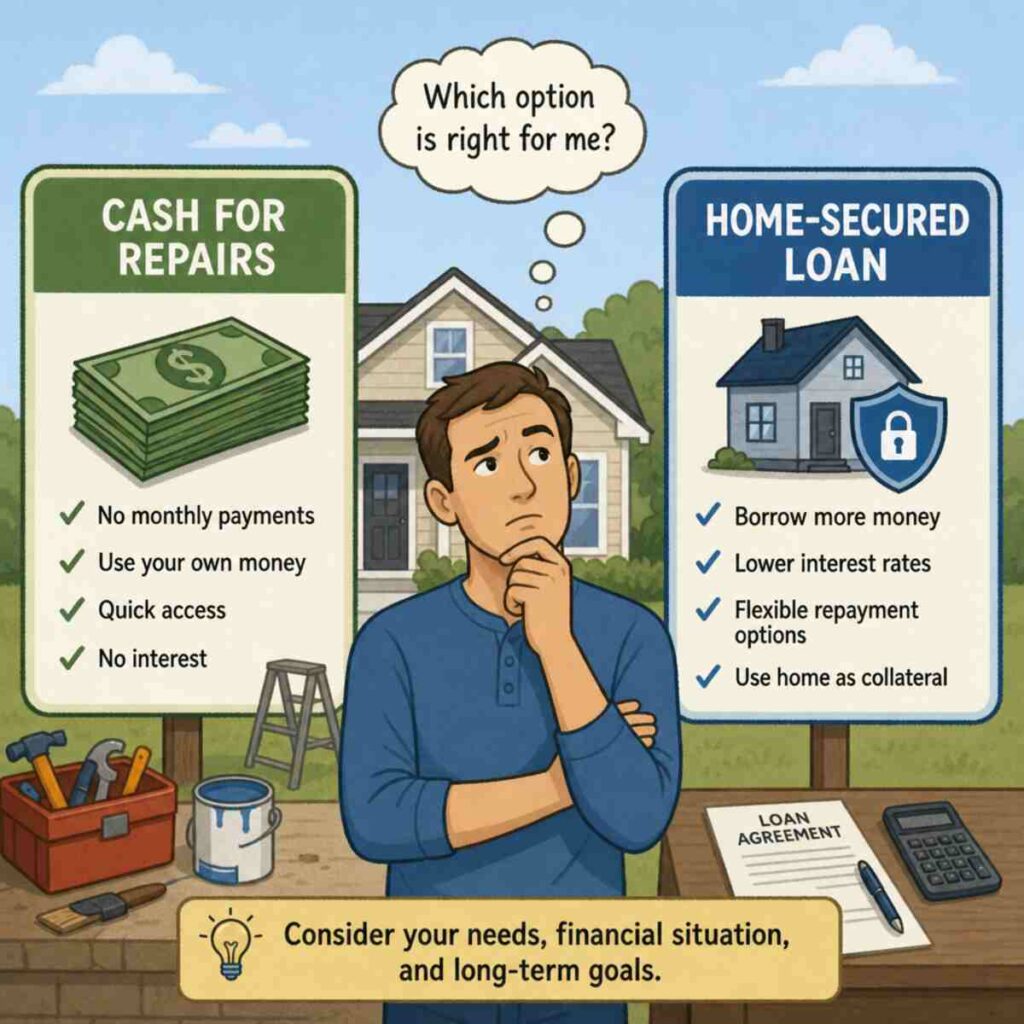
Example: You are planning a major kitchen, roofing, and structural renovation that will cost far more than a typical personal loan limit. A home equity loan or HELOC may be worth comparing, especially if the work substantially improves the home and you understand the collateral risk.
When neither may be ideal
Sometimes the best financing option is no loan at all.
Pause before borrowing if:
- You do not know the full project cost.
- Your emergency fund is already empty.
- The payment would strain your monthly budget.
- You are borrowing for nonessential spending.
- You are consolidating debt without fixing the source of overspending.
- You may move before recouping home loan closing costs.
- You are using a long-term loan for a short-term purchase.
In those cases, consider saving longer, reducing project scope, negotiating payment plans, using cash for part of the cost, or speaking with a nonprofit credit counselor.
How to choose between a personal loan and a home loan
Step 1: Name the purpose clearly
Write one sentence: “I am borrowing this money to _____.”
If the blank says “buy a home,” you are likely in home loan territory. If it says “replace a car transmission,” “consolidate credit cards,” or “cover a medical bill,” a personal loan may be more relevant.
If the blank says “renovate my home,” compare both. A small renovation may work with a personal loan. A major renovation may justify a home equity loan, HELOC, renovation mortgage, or cash-out refinance.
Step 2: Match the loan term to the life of the expense
A guru rule: do not finance a short-lived item with a long-lived loan.
Using a 20-year home equity loan for furniture, a vacation, or short-term bills can keep yesterday’s expense hanging around for decades. A personal loan’s shorter term may feel tougher monthly, but it can protect you from dragging out the cost.
Step 3: Compare APR and total dollars
APR matters, but it is not the only number. Compare:
- Amount borrowed
- Amount you actually receive after fees
- Interest rate
- APR
- Monthly payment
- Origination fees
- Closing costs
- Points or lender credits
- Prepayment penalties
- Total interest over the expected repayment period
- Total cost if you keep the loan to maturity
For mortgage offers, the CFPB recommends requesting the same kind of loan with the same features so you can compare apples to apples. It also warns borrowers to check whether the rate is locked and to review risky features like prepayment penalties or balloon payments. (consumerfinance.gov)
Step 4: Ask what happens if life gets messy
A loan that looks good in a spreadsheet can become painful if income drops, expenses rise, or a project runs over budget.
Ask:
- Could I still afford this payment after a job loss?
- Do I have emergency savings after closing or funding?
- What happens if rates rise on an adjustable product?
- What happens if my home value falls?
- What fees apply if I pay early?
- What late fees or default remedies could apply?
With a personal loan, the risk is usually credit damage, fees, collection activity, and possible legal action. With a home loan, the risk can include losing the property.
Step 5: Consider your timeline
If you need funds in days, a home loan may be too slow. If you are planning a major renovation three months from now, you may have time to compare home-secured products.
Timeline can also affect rate decisions. Mortgage rates can change, and a Loan Estimate may or may not include a rate lock. The CFPB advises borrowers to check whether the interest rate is locked because, if it is not, it can change. (consumerfinance.gov)
Step 6: Shop more than one lender
This is not the glamorous part. It is the profitable part.
Compare at least three offers when possible. For personal loans, look at banks, credit unions, and reputable online lenders. For home loans, compare lenders using the same loan type, loan amount, term, points, and lock period.
The CFPB notes that negotiation is common in mortgage shopping and that borrowers can ask lenders to waive or reduce fees, lower the interest rate, or lower points. (consumerfinance.gov)
Step 7: Check the tax story with a professional
Tax rules are too specific for guesswork. Mortgage interest deductibility can depend on when the debt was incurred, how much debt you have, whether the loan is secured by a qualified home, and how the proceeds are used.
If tax treatment is part of your decision, consult a qualified tax professional before you sign.
Step 8: Choose the loan you can live with, not just qualify for
Approval is not the same as affordability. A lender may approve a payment that technically fits its model but feels stressful inside your real monthly life.
Choose the loan that gives you the best blend of cost, risk, flexibility, and peace of mind.
Common mistakes to avoid
Mistake 1: Comparing interest rate only
A lower rate can hide higher costs. Always compare APR, fees, points, monthly payment, and total cost.
Mistake 2: Ignoring the term
A longer loan can lower the monthly payment while increasing total interest. The cheapest monthly payment is not always the cheapest loan.
Mistake 3: Using home equity for short-term spending
Using a home loan for temporary expenses can turn small financial stress into long-term secured debt.
Mistake 4: Assuming personal loans are always safer
Unsecured does not mean consequence-free. Missed personal loan payments can still damage credit and trigger collections.
Mistake 5: Assuming home loans are always cheaper
A home loan may have a lower rate, but closing costs and a long term can make it more expensive over time.
Mistake 6: Forgetting about cash to close
Home loans can require upfront money beyond the down payment. Closing costs, prepaid interest, insurance, and escrow deposits can surprise borrowers who focus only on the monthly payment.
Mistake 7: Taking a personal loan before applying for a mortgage
New debt can affect your credit score and debt-to-income ratio. The CFPB warns against applying for a lot of new credit in a short time when preparing for a mortgage. (consumerfinance.gov)
Mistake 8: Assuming a tax deduction will save the deal
A possible deduction should be a bonus, not the backbone of your decision. Many borrowers take the standard deduction, and home equity interest has specific use-of-funds rules.
Mistake 9: Not reading the fine print
Look for origination fees, late fees, prepayment penalties, balloon payments, adjustable rates, mandatory insurance products, and automatic payment requirements.
Mistake 10: Borrowing the maximum offered
The lender’s maximum is not your comfort number. Borrow what you need, not what you are offered.
Personal loan vs home loan: decision checklist
Use this quick filter before you apply.
Choose a personal loan if most of these are true:
- The expense is not tied to buying or refinancing a home.
- You need funding quickly.
- You want a fixed payoff date within a shorter time frame.
- You do not want to pledge your home.
- You can qualify for a reasonable APR.
- The total interest is manageable.
- The monthly payment fits even if your budget gets tighter.
Choose a home loan if most of these are true:
- The need is connected to buying, refinancing, or improving a property.
- You need a larger amount than a personal loan can reasonably provide.
- You have sufficient down payment or equity.
- You can wait for underwriting and closing.
- You understand the closing costs.
- You are comfortable using the property as collateral.
- You plan to keep the loan or property long enough for the costs to make sense.
Compare other financing options if neither list feels right. A 0% promotional credit card, contractor financing, savings plan, family loan, nonprofit credit counseling program, or government-backed renovation program may be worth exploring depending on your situation.
FAQ
Is a personal loan better than a home loan?
A personal loan is better when you need flexible funds quickly and do not want to pledge your home. A home loan is better when the borrowing need is property-related, larger, and worth the extra documentation and collateral risk. Better does not mean cheaper; it means better matched to your goal.
Which usually has lower loan interest rates?
Home loans often have lower interest rates because they are secured by real estate. Personal loans, especially unsecured ones, may have higher APRs because the lender has less collateral protection. Still, a shorter personal loan can sometimes cost less in total interest than a long home loan.
Can I use a personal loan for a home down payment?
Usually, this is difficult and often not allowed by mortgage lenders. A personal loan increases your debt and may affect your mortgage approval. If you are buying a home, ask your mortgage lender what sources of down payment funds are acceptable before borrowing.
Is a home equity loan the same as a home loan?
A home equity loan is one type of home loan. It lets you borrow against equity in a property you already own. A purchase mortgage is also a home loan, but it is used to buy the property.
Which loan funds faster?
A personal loan usually funds faster. A home loan generally takes longer because the lender must evaluate both the borrower and the property.
Which is better for home improvements?
For small repairs, a personal loan may be simpler. For larger improvements, a home equity loan, HELOC, cash-out refinance, or renovation loan may be worth comparing. If tax deductibility matters, remember that IRS rules for home equity interest depend on using the funds to buy, build, or substantially improve the home that secures the loan. (irs.gov)
Does a personal loan affect mortgage approval?
Yes, it can. A personal loan can affect your credit score, monthly debt obligations, and debt-to-income ratio. If you plan to apply for a mortgage soon, speak with a mortgage professional before taking on new debt.
Is personal loan interest tax deductible?
For personal expenses, generally no. The IRS lists installment interest incurred for personal expenses as nondeductible personal interest. (irs.gov)
Is home loan interest tax deductible?
It may be, if IRS requirements are met. Mortgage interest rules depend on loan amount, date of debt, whether the debt is secured by a qualified home, and how funds are used. Consult a tax professional for advice based on your return.
Should I compare APR or interest rate?
Compare both, but give APR serious attention because it reflects more of the loan’s cost. Also compare total interest, fees, monthly payment, and how long you expect to keep the loan.
Can I refinance a personal loan into a home loan?
Sometimes, a borrower may use home equity or a cash-out refinance to pay off personal debt. This can lower the rate, but it converts unsecured debt into home-secured debt. That can be risky if the original debt came from overspending or unstable income.
How many lenders should I compare?
Compare at least three when possible. For mortgages, request offers for the same type of loan and features so the comparison is fair. The CFPB specifically encourages apples-to-apples Loan Estimate comparisons. (consumerfinance.gov)
Bottom line
The personal loan vs home loan decision is not just about rate. It is about purpose, risk, fees, speed, term, tax treatment, and what happens if life changes.
A personal loan is simple, flexible, and often fast. A home loan can be powerful, larger, and potentially cheaper on rate, but it is more complex and secured by your property.
Choose the financing option that solves the problem without creating a bigger one.
Financial disclaimer
This content is for general educational purposes only and is not financial, legal, or tax advice. Loan terms, rates, eligibility, and tax treatment vary by borrower, lender, property, state, and current market conditions. Consult a qualified financial advisor, tax professional, or licensed lender before making borrowing decisions.