


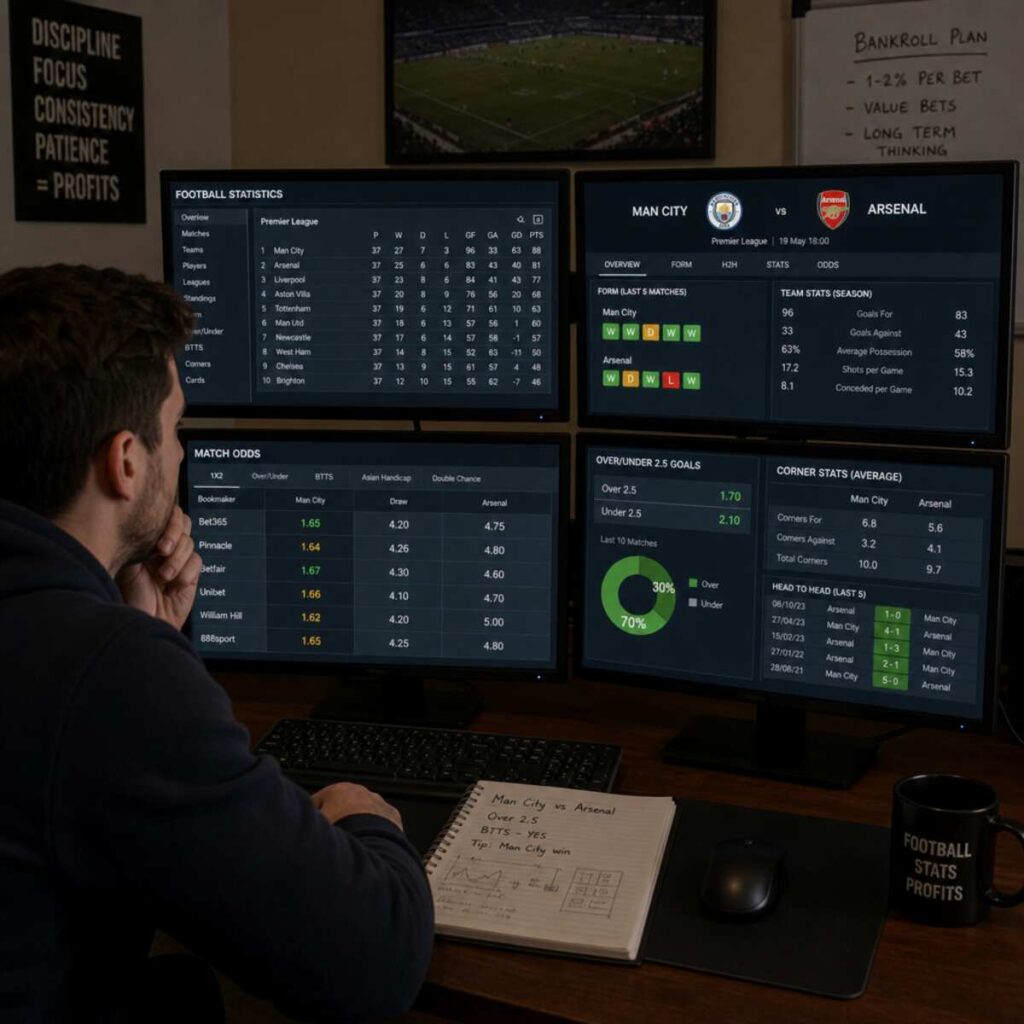
Whether you are a casual fan looking to add a little excitement to your weekend viewing or an aspiring professional bettor aiming to generate long-term profits, mastering the art of wagering requires far more than just a gut feeling about which team will win. The secret to long-term success lies in the numbers. Have the Best information about Banker of the day.
To consistently beat the bookmakers, you need a profound understanding of how markets work, how probabilities are calculated, and how to spot discrepancies in the lines. When you engage in Football predictions & daily match analysis (focused on understanding betting odds), your primary goal is to shift your mindset from simply predicting a match outcome to calculating the true mathematical likelihood of an event occurring.
In this comprehensive guide, we will break down the mechanics of football odds, explore advanced analytical concepts, and provide you with actionable strategies to elevate your sports betting game.
The Core of Football Betting: Demystifying the Odds
Before diving into advanced statistical models, you must fluently speak the language of the bookmakers: the odds. Betting odds serve two primary purposes. First, they dictate how much money you will win if your prediction is correct. Second, and more importantly, they represent the bookmaker’s estimation of the likelihood of an event happening.
Understanding how to read and compare different odds formats is the foundational step in professional sports analysis.
Decimal Versus Fractional Odds Comparison
Across the globe, bookmakers offer odds in various formats. The two most prominent in the football betting sphere are decimal and fractional. Understanding a decimal versus fractional odds comparison is crucial for quickly assessing potential returns.
- Decimal Odds (European Format): Popular across Europe, Australia, and Canada, decimal odds are the easiest to understand. The number represents your total return (including your stake) for every $1 wagered.
- Example: If Arsenal has odds of 2.50 to win, a $10 bet returns $25 ($15 profit + $10 original stake).
- Fractional Odds (UK Format): Traditional in the UK and Ireland, fractional odds show the potential profit relative to your stake.
- Example: Odds of 3/2 mean that for every $2 you wager, you make $3 in profit. A $10 bet at 3/2 yields $15 in profit, plus your $10 stake back, totaling $25.
While both formats convey the same mathematical reality, modern bettors heavily favor decimal odds. Decimal formatting makes it significantly easier to perform mathematical equations, calculate implied probabilities, and spot subtle differences between competing sportsbooks.
The Math Behind the Book: Probabilities and Margins
If you want to understand football odds, you need to understand the underlying probabilities they represent. Bookmakers do not simply guess the outcome of a match; they use complex algorithms to assign a percentage probability to every possible scenario.
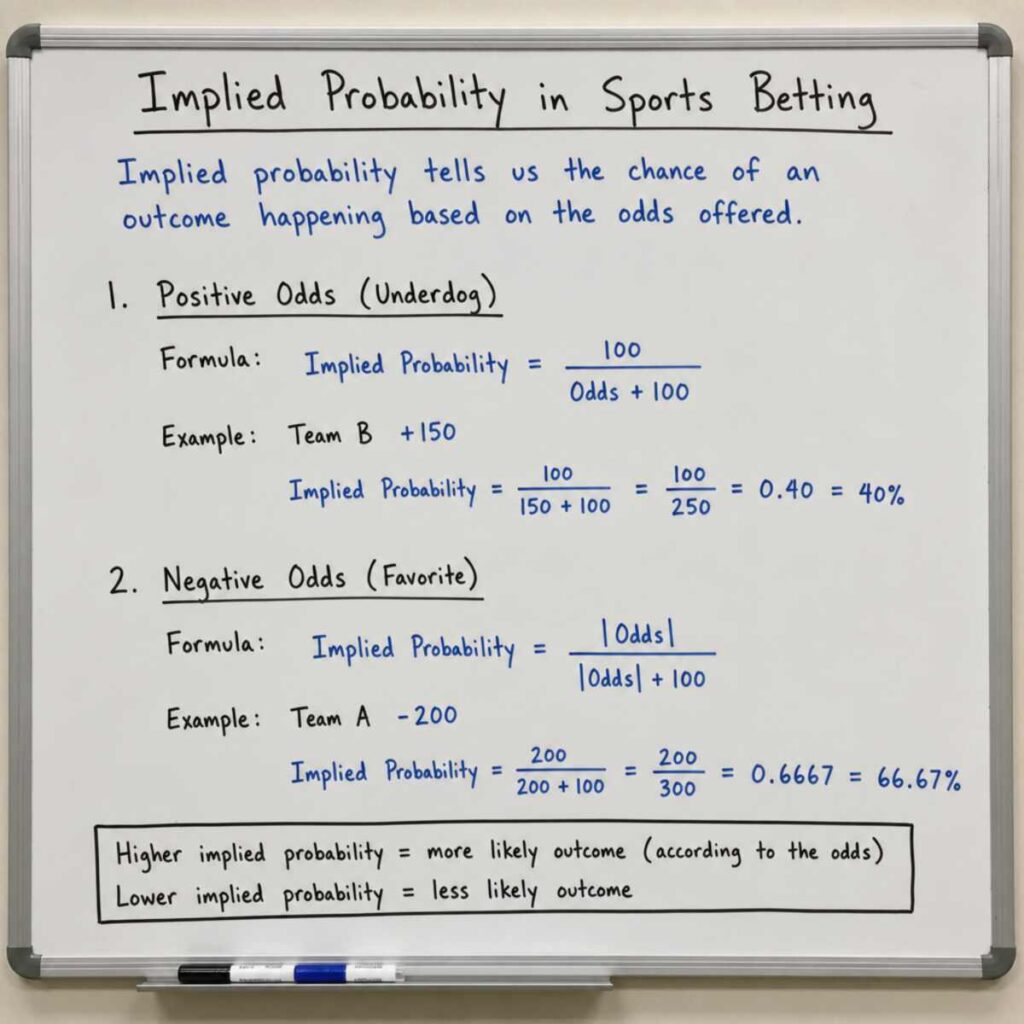
Implied Probability Calculation from Betting Odds
Every betting odd has a hidden percentage attached to it. This is known as implied probability. If you cannot convert odds into percentages, you are betting blindly.
The implied probability calculation from betting odds using the decimal format is astonishingly simple:
Implied Probability = (1 / Decimal Odds) * 100
Let’s look at a practical example of a standard 1X2 (Home/Draw/Away) market:
- Home Team Win: Odds of 2.00
- (1 / 2.00) * 100 = 50% implied probability
- Draw: Odds of 3.50
- (1 / 3.50) * 100 = 28.57% implied probability
- Away Team Win: Odds of 4.00
- (1 / 4.00) * 100 = 25% implied probability
How Bookmakers Set Their Margins and Vig
If you add up the implied probabilities from the example above (50% + 28.57% + 25%), you will notice the total does not equal 100%. Instead, it equals 103.57%.
Why? Because of the “vig” (vigorish), juice, or bookmaker’s margin.
Understanding how bookmakers set their margins and vig is essential to recognizing the hurdles you face as a bettor. That extra 3.57% is the “overround.” It guarantees that if the bookmaker balances their book—meaning they take the right proportion of money on all three outcomes—they will make a 3.57% profit regardless of who wins the match.
To be a profitable bettor, your football predictions must not only be more accurate than the general public’s, but they must also be accurate enough to overcome the bookmaker’s built-in mathematical advantage.
Finding the Edge: The Philosophy of Value Betting
The biggest mistake amateur bettors make is asking, “Who is going to win?” The professional bettor asks, “Are these odds higher than they should be?”
This concept is the absolute holy grail of sports betting: Value.
How to Identify Value in Football Markets
Value exists when your calculated probability of an event occurring is higher than the implied probability set by the bookmaker. If you flip a coin, the true probability of it landing on heads is 50% (odds of 2.00). If a bookmaker offers you odds of 2.20 (an implied probability of 45.45%) on heads, you have found value. Even if the coin lands on tails, it was still a mathematically brilliant bet.
Learning how to identify value in football markets requires you to create your own odds (your own true probabilities) and compare them to the market.
The Value Formula: Value = (True Probability * Decimal Odds) – 1 If the result is greater than 0, you have a value bet.
For example, imagine Manchester United is playing Chelsea. The bookmaker prices a Manchester United win at 2.50 (40% implied probability). Through your rigorous analysis, you determine that Manchester United actually has a 45% chance of winning.
- Calculation: (0.45 * 2.50) – 1 = 1.125 – 1 = +0.125.
Because the number is positive, this is a clear value bet. You will not win every value bet you place, but by consistently betting when the math is in your favor, variance will eventually smooth out, resulting in long-term profit.
Key Betting Markets Explained
While the traditional 1X2 market is the most common, professional bettors often find greater value in secondary markets where bookmakers might be slower to react to emerging data.
Asian Handicap vs European Handicap Explained
Handicap betting is designed to level the playing field when there is a clear favorite and underdog. However, the nuances between formats often confuse bettors. A thorough Asian Handicap vs European Handicap explained breakdown is vital.
European Handicap (EH): The European Handicap is a three-way market. It applies a whole-number goal disadvantage to the favorite, but crucially, the draw is still a possible betting outcome.
- Example: Real Madrid (-1) vs. Getafe.
- If you bet Real Madrid (-1), they must win by 2 or more goals for your bet to win.
- If Real Madrid wins exactly 1-0, the handicap result is a Draw. If you bet on Real Madrid (-1), you lose. You would have needed to bet on “Handicap Draw (-1)” to win.
Asian Handicap (AH): The Asian Handicap was created to eliminate the possibility of a draw, turning the bet into a two-way market. This format uses half-goals (0.5) and quarter-goals (0.25).
- Example: Real Madrid (-1.5) vs. Getafe.
- If Real Madrid wins by 2 or more, you win. If they win by 1, draw, or lose, you lose. There is no draw option.
- Asian Handicaps also feature whole numbers (e.g., -1.0). If Real Madrid wins exactly by 1 goal on an AH -1.0, the result is a “push” (void), and your stake is refunded.
Asian Handicaps generally offer lower bookmaker margins than European Handicaps, making them highly attractive to professional bettors.
Understanding the Over/Under Goals Market
Another wildly popular avenue is the totals market. Understanding the over/under goals market requires a shift away from analyzing who will win, and toward analyzing how the game will be played.
The standard line in football is 2.5 goals.
- Over 2.5 goals wins if the match features 3 or more goals (e.g., 2-1, 3-0, 2-2).
- Under 2.5 goals wins if the match features 2 or fewer goals (e.g., 0-0, 1-0, 1-1).
To master this market, you must analyze tactical matchups. A team with a high-pressing, attacking style playing against a team with a vulnerable defense but potent counter-attack is a prime candidate for an “Over.” Conversely, when two defensively rigid, possession-heavy teams meet, the “Under” becomes appealing.
Pre-Match Variables and Line Movements
Bookmaker odds are not static. From the moment they are released (the opening line) to the moment the referee blows the whistle (the closing line), the odds will shift.
Why Do Bookmaker Odds Fluctuate Before Kickoff?
If you have ever monitored a match during the week, you have likely wondered, why do bookmaker odds fluctuate before kickoff?
Odds move for two primary reasons:
- New Information: Weather changes, managerial sackings, or injury news will force bookmakers to adjust their true probability assessments.
- Market Action (The Weight of Money): Bookmakers want a balanced book to minimize risk. If an overwhelming amount of money is being wagered on Team A, the bookmaker will lower Team A’s odds to discourage further betting, while simultaneously raising Team B’s odds to attract money to the other side.
Tracking line movement, often referred to as “following the smart money,” can give you incredible insight into where sharp betting syndicates are placing their capital.
Impact of Player Injuries on Match Odds
Few things alter the betting landscape as rapidly as injury news. However, the impact of player injuries on match odds is often misunderstood by casual punters.
Not all injuries are created equal. The loss of a star striker might make headlines and cause the public to panic, but an analytical bettor looks deeper.
- Replacement Value: If the starting striker is injured, but the backup striker plays a similar style and the team’s tactical system generates high-quality chances regardless of the focal point, the odds should not drop significantly.
- Systemic Importance: Conversely, losing a deep-lying defensive midfielder who dictates the tempo and disrupts opposition counter-attacks might be disastrous for a team’s win probability, even if that player rarely scores goals or makes headlines.
Bettors who monitor training ground reports and anticipated lineups can grab immense value before the bookmakers have time to adjust their lines.
Quantifying Home Field Advantage in Soccer
“Home advantage” is a universally accepted truth in sports, but exactly how much is it worth? In betting terms, quantifying home field advantage in soccer is a complex but necessary calculation.
Historically, home advantage in top-flight European football equates to roughly +0.35 to +0.50 Expected Goals (xG) per match. However, this is not a blanket rule. You must adjust this metric based on specific variables:
- Travel Distance: A domestic cup match where a team travels 30 miles carries less home advantage than a midweek European fixture requiring a 6-hour flight across multiple time zones.
- Stadium Atmosphere: Hostile environments with steep stands close to the pitch (like Anfield or La Bombonera) statistically impact refereeing decisions in favor of the home team far more than stadiums with running tracks separating the fans from the pitch.
- Pitch Dimensions and Surface: Teams that train on artificial turf hold a significant advantage when hosting teams accustomed to natural grass.
How to Interpret Head-to-Head Records for Predictions
Media pundits love to cite historical matchups: “Team A hasn’t won at this stadium since 2012!”
While entertaining, you must learn how to interpret head-to-head records for predictions safely. Most head-to-head data older than two to three years is statistically irrelevant. A match that occurred five years ago featured different managers, entirely different playing squads, and different tactical philosophies.
Instead of looking at the last ten years, focus on recent tactical matchups. Does Team A’s current manager have a specific tactical setup (e.g., a low block) that historically neutralizes Team B’s current manager’s preferred style (e.g., possession-based Tiki-Taka)? That is the only type of head-to-head data that holds predictive value.
In-Play Dynamics: Mastering the Live Markets
Pre-match analysis is only half the battle. Modern sports betting offers the thrilling, fast-paced world of live wagering.
Factors Influencing Live Betting Odds Movement
In-play betting requires immense discipline because the odds update by the second. Understanding the factors influencing live betting odds movement allows you to anticipate market changes before they happen.
- Time Decay: The most predictable factor is time. As the clock ticks toward 90 minutes, the odds for the current result drop rapidly. A draw priced at 3.50 at kickoff might drop to 1.80 by the 70th minute if the score is still 0-0.
- Game State and Momentum: Bookmakers use algorithms to track possession, dangerous attacks, and shots on target. If the underdog goes a goal up early, the favorite’s odds to win will lengthen, but perhaps not as much as you’d expect, as algorithms factor in the favorite’s quality and the time remaining.
- Red Cards and Match Disruptions: A red card causes an immediate and massive odds shift. However, if a team goes down to 10 men in the 80th minute while defending a 2-0 lead, the win probability drops far less than if the red card occurred in the 20th minute at 0-0.
Live betting provides excellent opportunities to hedge pre-match bets or capitalize on teams that are visually dominating the game but haven’t yet scored.
Data-Driven Strategies: Moving Beyond Intuition
To achieve consistent success, you must eliminate emotion. The best bettors in the world rely on mathematics, statistics, and historical data to guide their decisions.
Advanced Statistical Models for Soccer Forecasting
The days of relying solely on league tables and recent form guides are over. Today, bettors utilize advanced statistical models for soccer forecasting to find a true edge.
The most prominent of these metrics is Expected Goals (xG). xG measures the quality of a chance by calculating the likelihood that it will be scored from a particular position on the pitch during a particular phase of play.
- If Team A wins a match 2-0, but the xG was 0.5 to 2.1 in favor of Team B, the final score lied. Team B actually created vastly superior chances but suffered from poor finishing or an incredible performance by the opposition goalkeeper.
By tracking xG over a season, you can identify teams that are “overperforming” (getting lucky) and are due for a regression, or teams that are “underperforming” (getting unlucky) and are on the verge of a positive bounce-back. Betting on these statistical regressions is highly profitable.
Role of Poisson Distribution in Football Betting
If you truly want to step into the realm of professional forecasting, you must grasp the role of Poisson distribution in football betting.
Poisson distribution is a mathematical concept that translates historical averages into a probability for variable outcomes. Because football is a low-scoring game where goals are independent events, it is perfectly suited for Poisson equations.
To use Poisson, you first calculate two distinct metrics for both teams:
- Attack Strength: How many goals does this team score on average compared to the rest of the league?
- Defense Strength: How many goals does this team concede on average compared to the rest of the league?
By cross-referencing Team A’s Attack Strength with Team B’s Defense Strength (and vice versa), the Poisson formula can generate the precise probability of every conceivable scoreline (1-0, 2-1, 0-0, etc.).
For instance, if your Poisson model dictates that a 1-1 draw has a 15% probability, but the bookmaker is offering exact score odds that imply only an 8% chance, you have uncovered a massive mathematical value bet.
Protecting Your Capital and Avoiding Mistakes
You can have the most accurate predictive models in the world, but if you lack discipline and capital management, you will eventually go broke. Bookmakers thrive not just on inaccurate predictions, but on human psychology and poor money management.
Bankroll Management for Consistent Sports Betting
The most crucial skill any bettor can possess is bankroll management for consistent sports betting. Your bankroll is your inventory; if you lose it, you are out of business.
- Define Your Bankroll: Segregate your betting money from your daily living expenses. This must be money you can afford to lose.
- Unit Sizing: A standard approach is “flat betting,” where you wager exactly 1% to 2% of your total bankroll on every single bet (one unit). If your bankroll is $1,000, your unit size is $10 to $20.
- The Kelly Criterion: For advanced bettors, the Kelly Criterion is a formula that dictates exactly how much of your bankroll you should wager based on the perceived value of the bet. If you have a massive edge, the formula tells you to bet more; if the edge is slight, you bet less.
Strict bankroll management protects you during inevitable losing streaks (variance) and ensures that your capital grows steadily during winning streaks.
Common Pitfalls in Professional Match Analysis
Even seasoned analysts can fall victim to psychological traps. Awareness of the common pitfalls in professional match analysis is your first line of defense.
- Confirmation Bias: This occurs when you decide who you want to win, and then selectively look for statistics to support your pre-determined narrative while ignoring data that contradicts it. Always let the data lead you to the conclusion, not the other way around.
- Recency Bias: Overreacting to what happened last week. Just because a top-tier team shockingly lost 4-0 to a relegation candidate last weekend does not mean they have suddenly become a terrible team. The market often overreacts to recent anomalies, creating value on the other side.
- Chasing Losses: The absolute cardinal sin of betting. If you lose three bets on a Saturday afternoon, do not double your stakes on a Saturday evening match you haven’t researched just to win your money back. Accept the loss, trust your system, and move on to the next day.
Conclusion
Succeeding in the modern sports betting landscape is a demanding but highly rewarding endeavor. By moving away from emotion-driven guesses and fully embracing Football predictions & daily match analysis (focused on understanding betting odds), you tilt the scales of probability in your favor.
Remember, the goal is not to predict the future with 100% accuracy—no one can do that. The goal is to accurately calculate probabilities, identify when the bookmaker has made a pricing error, and exploit that value over a long period.
Master the math behind the margins, utilize advanced data like xG and Poisson distribution, navigate the nuances of Asian Handicaps, and, above all else, protect your bankroll with strict discipline. When you treat football betting not as a weekend gamble, but as a calculated financial investment, you take your first true steps toward beating the bookmaker.